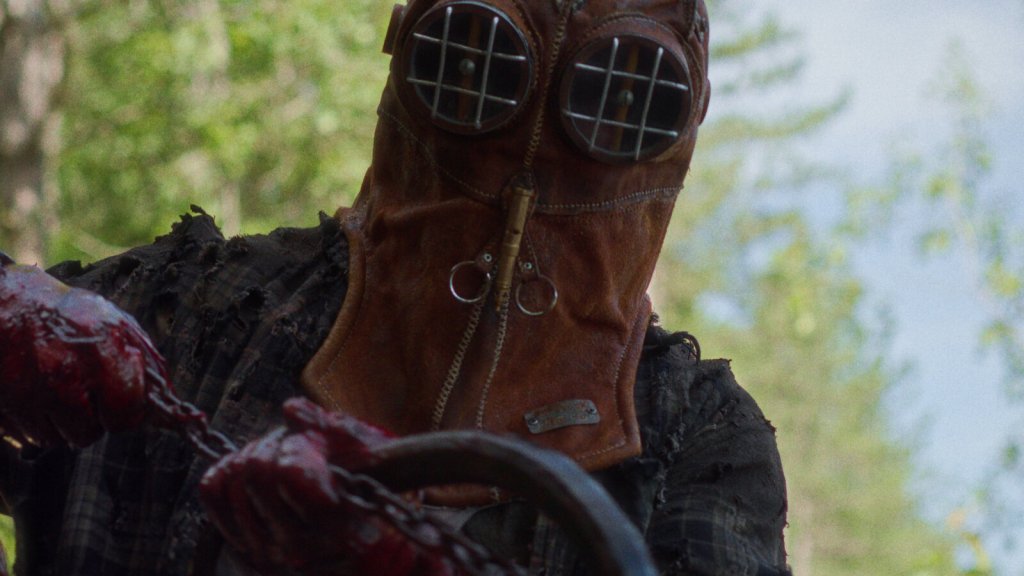
The 2024 Canadian slasher movie In A Violent Nature follows a man on the path of revenge… I think?
This fills the same campy (ha) vibe as the first Friday the 13th movie, in that there are stupid young people with no spacial awareness hanging around in deserted woods. Oh, and there’s also the sadist-killer that masks their face and never talks.
This Canadian slasher gives us a mostly over-the-shoulder POV to one man’s plodding rampage. You can only assume the killer’s motivations, since there’s about 4 minutes of dialog in this 1 hour and 34 minute movie. Unless you’re fluent in long, atmospheric silence and the sound of twigs snapping under boots, you’re mostly left to vibe with the gore.
Set in the classic horror setting of “random nowhere forest,” the film lovingly embraces the stupid teens + woods + masked killer formula. It’s never clarified what these characters are doing in these desolate grounds, but that doesn’t really matter because they won’t be doing it for long. As for our killer? Faceless, wordless, relentless. Classic. You won’t get much insight into his motivations beyond “kill things in creatively unpleasant ways.”
That’s all about what I can say without spoiling anything in this movie. If you don’t mind spoilers, keep reading. Otherwise, stay at the trailhead.
Should you be interested in watching this movie for some reason, I rented it from Amazon Prime.
reading ahead
We’ve already established that this is not a good movie, yes. But now, I can actually tell you why it’s so bad, in my opinion.
Let me preface this by saying: slashers aren’t my favorite subgenre of horror. I do love gore and body horror, so I can appreciate a well-executed (badumtss) kill. What I don’t love is when that’s all a movie has going for it. A good slasher usually still has some kind of plot motivation behind the mayhem. Take Friday the 13th, which is what I believe to be the obvious American counterpart to this Canadian film. Jason Voorhees may not be subtle, but we know what he wants: revenge against camp counselors and, broadly, anyone associated with Camp Crystal Lake. Not a deep motive, but a motive nonetheless. If we don’t have motive, we have violent brainrot.
A lot of the pieces are filled in for us in Ft13 — plot pieces with contextual and character-building importance, mostly from other characters telling stories. In a Violent Nature, on the other hand, barely gestures at a plot. The most backstory we get in the beginning of the movie is a memory reflected in a mirror: a mother gifts her young son (our killer, Johnny) her necklace. When a man removes that same necklace from the earth above Johnny’s grave, Johnny erupts from the ground and the killing begins. That’s about all we get. There’s a throwaway line from an early victim, off-screen, about a group of teens coming to the area later. Why? No clue. Are they connected to Johnny in any way? Also no. They just… show up. And he kills them. There’s no real sense of why Johnny targets these people. At least in other slashers, the group has some tenuous link to the killer or thread of causality — guilt by proximity, if nothing else. Here, they feel like randoms who wandered onto the wrong set.
The lack of dialogue doesn’t help. And I mean seriously—there’s almost no talking. Our killer doesn’t speak (fine, classic), but neither does anyone else, really. Compared to Friday the 13th, where we at least get character interactions, names, relationships, and someone to root for, In a Violent Nature gives us… two engaged people, one of whom has a penis small enough to wear a wedding ring. There’s also a brief scene where two female characters flirt with one another by the lake, and we’re led to believe that this has been a long-standing situationship. That’s the sum total of character development. You’re not rooting for anyone, or conversely hoping for anyone’s death! You’re just watching.
Something interesting about this movie is that it really only follows the POV of the killer. I actually liked this at first; it felt like a deliberate, artistic choice that uniquely flipped the slasher genre on its head. That is, until we were like 10 minues into the movie watching the back of the killer’s head move through the woods and treeline in silence. It feels like an artistic choice, except when it isn’t. Occasionally, the camera shifts—usually for a money shot of a gory death—but mostly we’re stuck following Johnny’s slow, unrelenting march through brush and trees.
This technique could’ve been more effective if it had either committed to the bit or used it more sparingly. At first, the minimalist soundscape—the crunch of twigs, buzzing insects, the stillness—was genuinely eerie. But with so little happening between kills, the tension fades. Maybe audiences (myself included) are just conditioned to expect more action or interaction, especially in horror. I respect director Chris Nash’s attempt to reframe the slasher through restraint. Can we call plotlines and character development “filler” when we’re all just here for the grusome kills? The silence, the emptiness, the POV perspective—it’s bold. But the commitment wavers. The killer’s POV is eventually dropped in favor of more conventional framing, and the artistic ambition starts to feel half-hearted.
And honestly, the kills aren’t terrible. I wasn’t super into the yoga girl’s death, which to my understanding, was the most impressionable to viewers. If you haven’t seen this movie: Basically, one of the victims are doing yoga at the edge of a cliff in the woods. When our killer reaches her, he drives a hook on a chain through her lower back out of her belly button, spins her around to face him, yanks said hook on a chain further through her abdomen, bashes the hook into her head, and then proceeds to pull on the chain until her spine shatters and her head is pulled through her stomach. LOL. Obviously, I know these types of movies aren’t loved due to how realistic they are, but my girl is standing sholders back, up straight, knees locked as Johnny spins her around pulls her outsides inside, and then back outside. Sure, it was definitely an original and inventive death, but maybe a bit too exagerrated for me to fully enjoy it.
One death that I did find effective was the park ranger’s. At some point, the teens get help from the park ranger, who is revealed to have previosuly fought and killed Johnny when he resurrected previously. Sure! So, we have motive and tension: two existing advesaries facing each other once again. As the older, experienced authority figure, the ranger puts himself between the teens and Johnny, only for Johnny to immediately paralyze him from the neck-down. But [un]fortunatly, it doesn’t end there. The ranger’s eyes move panicked from side to side as Johnny drags him from the open field to a shed with an automatic log splitting machine. There’s no music, no dramatic zoom, just the sound of an automatic log splitter doing its grim work. The ranger watches from the floor, helpless, as Johnny demonstrates what’s about to happen to him — first with a short log, then the ranger’s hand… then his neck. The entire sequence is done from a right-above-the-floor shot, so that the ranger’s head is mostly centered the entire time. The scene is stomach-turning and genuinely memorable. It’s the one scene that stuck with me.
I really don’t think the ending is left purposefully ambigious. It just feels unfinished. After leaving Johnny’s mother’s necklace on a gas canister, the final girl, Kris (AKA, the female fiancée), makes it out of the woods and gets a ride from a passerby. Sensing that Kris has just been subject to something very traumatic, the driver recounts a story about her own brother being mauled by a bear. I read a review claiming this exchange suggests some broader motif about violence and nature, but that interpretation feels like a stretch. How are we supposed to connect Johnny’s resurrection, immortality, and killing spree with a metaphor of the natural world? You might be able to draw that line if Johnny were just a regular guy—an embodiment of mankind’s innate violence or desire for domination—but the film leans too heavily into the paranormal for that to land. Both Kris and the driver’s brother survive their respective attacks, but the film offers no real structure to support a deeper metaphorical reading.
Even the existence of a “final girl” in this movie feels frustrating. I usually love this trope when it’s done well—especially in a 21st-century horror film—but it’s used lazily here. The final girl is typically someone who undergoes adversity and emerges stronger, her survival serving as a kind of narrative reward for her resilience or transformation. But we know virtually nothing about Kris before we’re shoved into her perspective in the final act. Her only defining trait up to that point is being someone’s fiancée. We learn she and her partner had planned to burn down the firewatch tower, but when she sees him get beaten to death by Johnny, she silently leaves the necklace (which somehow seems to matter?) and runs.
And that necklace—how did she even know it was important? When was it established that Johnny wanted it back? She’s shown wearing it briefly earlier on, but there’s no explanation for how she got it or why it matters to the plot. Once in the car, Kris says nothing to the driver or to the viewer. She’s visibly traumatized, and yes, we can infer some resourcefulness in her escape, but that’s really all she’s given. “Final girl” status requires more than just survival.
This isn’t just one instance of a trope being misused. This movie is stuffed with underdeveloped ones: the masked, silent killer; the sexualized young victims; the cursed or haunted wilderness setting. None of these tropes are expanded upon or subverted in meaningful ways. Instead, they feel like boxes checked off on a slasher movie template—references without resonance.
In short: In a Violent Nature tries to do something different, and I give it credit for that. But different isn’t always better. For all its style and atmosphere, the film is hollow at its core. Without character, motive, or even narrative cohesion, it ends up feeling like a slow-moving showcase for practical effects—and not much else. There are generic horror movie stereotypes employed left and right, but no chops to support those stereotypes being there.
If you watched the movie, what did you think? Was there an effective plot in there somewhere? How did you feel about that ending?
 under review
Leave a comment