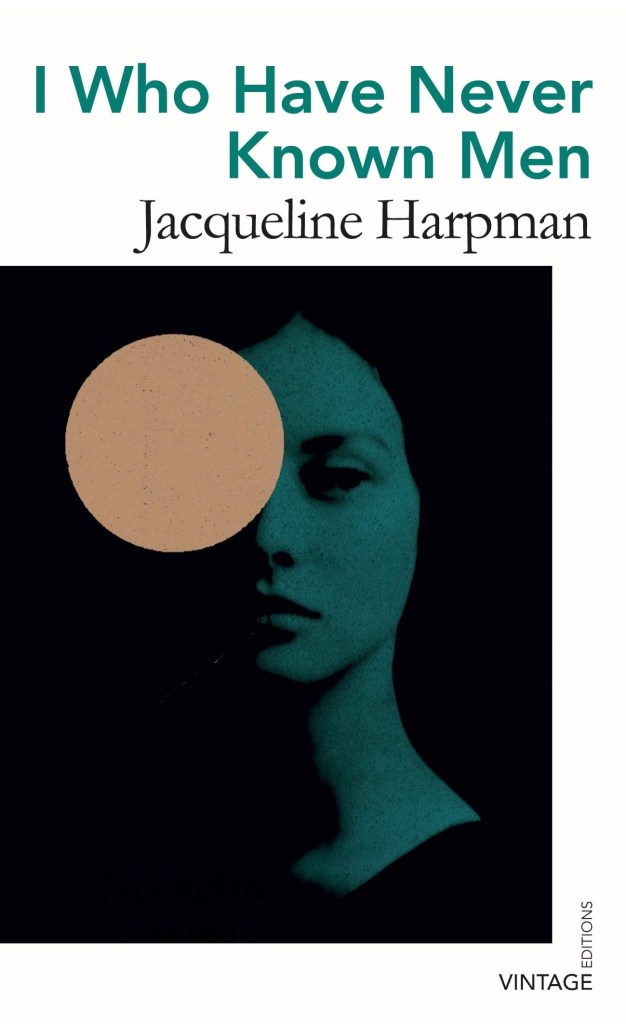
This is a short book, but not an easy one. Sparse, haunting, and bleakly beautiful, I Who Have Never Known Men drops you into a post-apocalyptic world and leaves you there, quiet and suspended, with only the narrator’s stark voice for company. Jacqueline Harpman’s prose is precise and emotionally muted, yet devastating. You won’t find action or clarity here, but hunger. Loneliness. Deep, existential ache. It’s not a book about answers — it’s about how long you can survive without them.
Harpman published this story with Transit Books in 2019, originally in French. I actually listened to an audiobook of this piece, which is available on Spotify & narrated by Nikki Massoud. Considering the nature of this book, hearing someone else recount the story of the narrator felt especially powerful.
Reading Ahead
Forty women live locked underground in a cage. Most of them remember the world before — families, jobs, sunlight. But one woman, the youngest, remembers nothing else. She was born (or taken?) too late. She’s never known a man. Never known a life outside this barren prison. Her world consists of thirty-nine women, three silent male guards, and sterile routine. Being the youngest of the captives, our narrator is often ostrasized by the ther women, since talking to this young girl about the world before only leads to pain and underscores just how hopeless it would be to tell this innocent person about opportunity, experience, and life outside of their cell — all of which would never be available to her.
One day, without warning, the alarms sound. The guards vanish. The cage unlocks. The women are free, but into what? They emerge into a flat, lifeless landscape, sun-bleached and desolate. No animals. No buildings. No food. No signs of other humans. Just the wind, the dust, and each other.
At first, they try to survive as a group, trudging across the empty land in search of anything. But as days stretch into years, their numbers dwindle. Hunger thins them. Exposure kills them. Grief takes its toll. And gradually, the narrator — always the youngest, always the outsider — becomes the only one left.
We follow her through decades of solitude. She finds shelter in an abandoned bunker. She keeps a journal. She catalogs her thoughts, her physical decline, her desperate wondering. What was the purpose of the cage? What ended the world? Why was she spared? Why has no one come?
But there are no answers. The book ends as it began: with silence.
There’s no exposition dump, no heroic twist, no satisfying reveal. That’s part of what makes it brutal and brilliant. The horror here is not event-driven. It’s the slow, steady erosion of meaning. We never learn about the guards, why they imprisoned these women, nor the events immediately leading to this desolate, scroned earth.
The narrator’s very identity is shaped by deprivation. She is defined by what she’s never had: never seen a tree, never heard music, never known a man’s voice. She has no name. No memories. No cultural context. Her story isn’t one of loss, it’s one of never having had the chance to lose in the first place. That makes her uniquely resilient in that she quite literally has nothing to lose. However, it also makes her hollowed-out.
Isolation as Identity
The narrator isn’t just alone — she is defined by her isolation. Her inner world is vast because her outer world is so empty. Harpman builds a portrait of a person who is fundamentally unknowable, even to herself. What does identity mean when it’s not reflected back by anyone or anything? Without language for emotion, without shared memory, without even the basic vocabulary of relationship, who is she?
At one point, the narrator claims, “I am the only witness of myself.” That line carries unbearable weight. Without others to affirm her experiences, she becomes both subject and object — perceiver and perceived. Her voice becomes a kind of echo chamber, not just narrating her life, but forming it. And that voice is eerie in its flatness. Not cold, exactly, but stripped of drama. The absence of emotional context isn’t just a stylistic choice; it’s the point. She cannot mourn what she never had. Her detachment is not apathy, it’s survival.
Over time, the book invites you to question whether the narrator is even a person in the traditional sense — or a kind of vessel. A human shape formed entirely out of lack. Isolation isn’t something she escapes or transcends. It is the only condition she has ever known, and it becomes the lens through which we’re forced to experience the story. That makes for a reading experience that feels more like inhabiting a mind than observing one.
The Futility of Knowledge
So much of the book revolves around questions that will never be answered. Who built the cage? Why were the women imprisoned? What happened to the world? The narrator poses these questions again and again, not as a way to solve them, but as a way to keep thinking. Her inquiries aren’t investigative — they’re performative. A ritual. A placeholder for a human need that has nowhere to go.
She writes: “I have asked myself all the questions, and I have no answers. Yet I go on asking.” Harpman doesn’t just omit exposition, she refuses it. The novel doesn’t flirt with the idea of clarity, but it outright denies it. The reader, like the narrator, is made to sit with the discomfort of never knowing. And eventually, that uncertainty becomes its own kind of landscape: flat, endless, hostile.
What’s chilling is that the narrator knows knowledge would change nothing. Answers, even if she found them, would not bring back the others. They would not return the world. They would not erase her loneliness. And yet she seeks them anyway. Because seeking is the only active thing left to her. It’s the final echo of what makes her human.
In my opinion, there are some interesting parallels with Margaret Atwood’s The Handmaid’s Tale. Of course, I won’t go into any spoilers about that work (although it was published in 1985 — if you haven’t read this book yet, get on it!), but both take place in a dystopian society where women are imprisoned and striped of their freedom/autonomy, in a sense. However, Atwood’s work outlines strict rules and hierarchies via the wives. Harpman provides no such clarity for us. In fact, the guards do not communicate with the prisoners at all — they do not take advantage of them, asssault them, or even look at them. These woman are treated as though they do not exist, and we never get an explanation as to why.
This is a bleak method to move around a storyline, but it works well given the content. At first, I found myself a tad annoyed that none of the older women had disclosed any detail that could give us an inkling of what caused this mayhem, especailly since they still recalled memories from those before times. Of course, knowing the ‘rules’ of dystopia or even the cause of this disaster does not matter at all. I appreciate the open-endedness a bit more; not only since this allows readers to interpretate their own meanings and endings, but by denying us those likely grusome and dramatic details, Harpman declines to make her work performative. We’re only left with what matters now: what follows.
The book suggests that knowledge — or the pursuit of it — is not only futile, but possibly irrelevant. The instinct to know persists, even when knowledge has no utility. And in that way, the narrator’s mind becomes its own kind of prison: a space where thought must continue, even if it leads nowhere. It’s not knowledge she’s after, it’s the motion of seeking, the shape of curiosity mimicking life that could never be fully realized.
Early in thier imprisonment, the other women would recount their lives to each other. The other women remember men, love, family. They mourn. The narrator does not, and she can’t. She listens, but doesn’t understand. Even among others, she is fundamentally alone. This becomes more haunting as she outlives them. Her solitude isn’t just physical; it’s emotional. There’s no one left who shares her perspective, but I suppose there never was.
Navigating Relationships in Dystopia
One exception to the above claim could be Anthea, another one of the female prisoners. The child also forms bonds with the other women in the group, but Anthea is the one who provides consistent guidance and emotional support.
The narrator’s relationship with Anthea is perhaps the closest thing she has to intimacy. Anthea becomes a nurturing figure, and tries to reach her, to teach her about emotions, to explain things like desire and memory. But it’s a one-sided effort. The narrator remains detached, not out of cruelty, but because there is no bridge between them. At one point, Anthea weeps, and the narrator watches with fascination rather than sympathy. “She was moved in a way I could not understand,” she notes.
This gap between them is not just emotional; it’s ontological. They do not occupy the same human experience. Anthea represents what was lost, while the narrator represents what is left. And when Anthea dies, there’s a sense that the narrator hasn’t lost a person so much as a possibility — the last fragile thread connecting her to a world she never understood.
It is much too late that the narrator does discover that she is not devoit of feeling, and that she has loved too. At the end of the book, she confesses, “I was forced to acknowledge too late, much too late, that I too had loved, that I was capable of suffering, and that I was human after all.” After coming to this realization, we know only that our narrator is alone, and is unlikely to interact with another human for the remainder of her life.
Their relationship underscores one of the book’s cruelest ideas: that empathy requires common ground. And in the absence of shared experience, even empathy becomes meaningless. The narrator may want to understand, may mimic concern, but it is never realized until after she’s lost these connections.
The Meaninglessness of Hope in Dystopia
The passage of time in the novel is glacial, brutal, and unrelenting. You feel every year — not because of what happens, but because of what doesn’t. There’s no growth, no society, no climax. Just aging. The body weakening. Hope calcifying. In that way, time is the greatest antagonist.
Despite everything, the narrator keeps walking. She records her thoughts. She imagines futures, though she has no reason to. She plans for survival, even when survival itself has lost any practical purpose. This persistence is chilling. What drives her is unclear, and that ambiguity is the point.
What Lingers
By the end, we’re not just watching someone survive. We’re watching someone exist, with no promise of connection, resolution, or recognition. And that’s what makes I Who Have Never Known Men so haunting. It’s not about what’s lost. It’s about what was never possible.
This book doesn’t offer catharsis. It offers an unflinching meditation on loneliness, silence, and the human need to make meaning — even when the universe offers none.
If you pick it up, know that it will not give you what you want. It might not even give you what you need. But it will leave a cold handprint on your brain.
You won’t forget it. You just might not know what to do with it.
 under review
Leave a comment